
Hard to predict results of raising legal age to purchase cannabis, says expert / Difficile de prédire les résultats de l’augmentation de l’âge légal pour l’achat du cannabis selon un expert

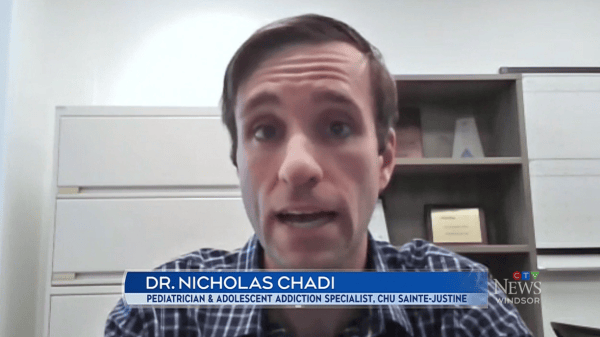
Interview with Louise Martin and Dr. Nicholas Chadi, CBC News, PEI, May 6, 2026

The P.E.I. government is considering raising the legal age to purchase nicotine pouches and cannabis to 21. CBC News: Compass host Louise Martin speaks to a pediatrician and researcher from Quebec, where the legal age to purchase cannabis is already 21.

Watch full interview here

Experts say age limits on nicotine pouches, cannabis not a perfect solution for protecting youth / Les experts soulignent qu les limites d’âge sur l’achat des sachets de nicotine et du cannabis ne sont pas une solution parfaite pour protéger les jeunes

By Gwyneth Egan, CBC News, PEI, with comments from Dr. Nicholas Chadi, May 6, 2026

Prince Edward Island is considering raising the age at which nicotine pouches and cannabis can be purchased, but experts say it’s not a catch-all solution.

Currently, nicotine pouches can be bought at pharmacies by anyone over 18, and cannabis can be bought by anyone over 19.

P.E.I.’s Health Minister Cory Deagle says he wants the minimum age increased to 21 — which would bring it in line with existing tobacco and e-cigarette legislation.

“Age is an important question, but I think an even more important question is what are all of the different policies, rules and regulations that come around it,” said Nicholas Chadi, a pediatrician and researcher who specializes in adolescent and addiction medicine.

“One thing is having policies, rules and regulations in place, and the other thing is making sure they’re enforced, but also controlling products that can come from other sources and in other ways.”

Chadi said many experts say the brain continues to mature beyond the age of 20 and that there could be a rationale for pushing up the age of legal purchase beyond 21.

But at the same time, he said discussions with many of his colleagues focus less on a specific age limit, and more on the different rules and regulations that exist around such substances.

“We’re talking about marketing and policies around products and how they’re verified and controls around what they can contain,” he said.

“Having the age question tackled alone will not be sufficient.” (Full story)

Les ados qui vapotent peuvent inhaler jusqu’à cinq paquets de cigarettes par jour en nicotine / Teens who vape can inhale up to the equivalent in nicotine of 5 packs of cigarettes per day

Par Hugo Duchaine, avec commentaires du Dr Nicholas Chadi, Journal de Montréal, 27 mars 2026

La santé de nos adolescents est alarmante s’inquiètent des experts puisqu’ils sont moins actifs qu’avant, dorment mal et ne mangent pas assez bien. Une bombe à retardement qui risque de peser lourd sur notre système de santé.
Les ados qui vapotent fréquemment peuvent inhaler l’équivalent de cinq paquets de cigarettes en nicotine en une seule journée.

« C’est un enjeu majeur de santé publique », tranche le Dr Nicholas Chadi, pédiatre au CHU Sainte-Justine et chercheur en toxicomanie.

La cigarette électronique ou vapoteuse est désormais omniprésente dans les cours d’école. Les adolescents sont deux fois plus nombreux qu’il y a dix ans à l’utiliser.

Rapidement, un jeune qui vapote peut inhaler une quantité phénoménale de nicotine, dépassant de loin la cigarette.

« Fumer un ou deux paquets de cigarettes par jour, c’est long. Faut les enfiler et ça sent fort. Mais la vapoteuse, on l’a au bout des doigts. Les liquides sont très concentrés et on peut fumer l’équivalent de 5 paquets de cigarettes », explique le spécialiste. (…) Article complet

Quelles solutions pour aider les jeunes à décrocher du vapotage? / What are the solutions to help youth quit vaping?

Entrevue avec Maude Rivard avec commentaires du Dr Nicholas Chadi, Sur le Vif, Radio Canada, 28 janvier 2026

«À partir de 2015 jusqu’à 2020, il y a eu une augmentation rapide des taux de vapotage chez les jeunes du secondaire», note le Dr Nicholas Chadi.

Le pédiatre et clinicien-chercheur spécialisé en médecine de l’adolescence et en toxicomanie pédiatrique, le Dr Nicholas Chadi, explique qu‘« au Québec, les pharmaciens peuvent prescrire la thérapie de remplacement de la nicotine chez les adolescents […], mais pour une durée maximale de 12 semaines ».

Il ajoute que plusieurs types de ressources en ligne existent aussi, notamment avec l’aide de messages textes ou d’applications sur le téléphone intelligent. Écouter l’entrevue complète ici

Canada’s doctors worried about youth using caffeine pouches / Des médecins canadiens inquiets de l’utilisation des sachets de caféine chez le jeunes

By Omar Mosleh, Staff Reporter, The Star, with comments from Dr. Nicholas Chadi, January 4, 2026

Caffeine pouches are easy to find, and some are marketed to youth. Their popularity is driven by young people’s videos on platforms such as TikTok. LyvWel caffeine pouches were purchased on Amazon by a Star reporter. They’re used by placing them in the gums to deliver a quick hit. Health experts say more should be done to restrict access to such pouches by youth.

They come in flavours like bubble gum, pink lemonade and red gummy bear. They resemble the kind of silica gel packet you find in packaged food, but instead of sucking up moisture, they’re placed in the gums to deliver a quick, potent hit of caffeine straight to the bloodstream.

The sale of caffeine pouches is illegal in Canada, but the unregulated products can be easily purchased online. The Star has also spotted them for sale at least one Toronto convenience store. Some of the pouches purportedly contain nearly three times as much caffeine as a single can of Red Bull. The products are popular among youth, experts say, driven by videos of young people trying them on social media platforms such as TikTok. (…)

What’s particularly concerning is that the products come in fruity and candy flavours, which might make them more enticing to youth, who would be more vulnerable to adverse effects of high caffeine intake, said Dr. Nicholas Chadi, a pediatrician and associate clinical professor at University of Montreal who specializes in adolescent and addiction medicine.

They follow a trend of sweet-flavoured nicotine pouches, of which only one brand is approved in Canada and must be obtained through a pharmacist for smoking cessation, and flavoured vapes.

“I’m quite concerned by the rapid emergence of a very wide range of products that seem to be considered quite benign among young people,” Chadi said. “I’m very concerned about the fact that there’s little attention around caffeine pouches when there is still harm.” (Full story)

Nicotine pouch use increasing among Quebec teens despite new rules meant to limit access / L’utilisation des sachets de nicotine augmente auprès des ados au Québec malgré les nouveaux règlements devant limiter l’accès

A CBC news report with comments from Dr. Nicholas Chadi, CBC News, Montreal, December 19, 2025

Nicholas Chadi, a pediatrician specializing in adolescent and addiction medicine at CHU Sainte-Justine, says there is a ‘drastic’ increase in the use of nicotine pouches in Quebec among high school students. He shares the risks associated with nicotine pouches, which are highly regulated by Health Canada, but continue to be sold illegally in corner stores across the country. Full story here.

Nicotine pouches are being illegally sold in corner stores across Canada / Les sachets de nicotine en vente illégale dans les dépanneurs à travers le Canada

A story produced by Britnei Bilhete, CBC News, with comments from Nicholas Chadi, December 3, 2025

A CBC News investigation has uncovered outlawed nicotine pouches, in high dosages and fun flavours, are still readily available for sale in corner stores across the country, despite new federal regulations meant to limit their access and deter youth.

In August 2024 the federal government limited the sale of nicotine pouches to pharmacies over growing concerns raised by multiple health groups about their popularity among non-smokers and youth. 

Nicotine pouches are highly regulated by Health Canada as natural health products for those 18 and over and are supposed to function as a tool to help people quit smoking. (…)

“Nicotine, in any form, is a risk for a young and developing brain,” said Dr. Nicholas Chadi, a pediatrician and clinician at Sainte-Justine University Hospital Centre in Montreal who specializes in adolescent and addiction medicine.

Chadi says he’s seeing more and more young people using pouches in flavours and doses that are not authorized for sale in Canada. He says the fact that the pouches are discreet and deliver a significant amount of nicotine to the body is attractive to youth. He says nicotine can increase alertness, focus, heart rate and bring a pleasurable feeling that lasts 30 to 60 minutes. 

But young people can be especially vulnerable to its negative effects. “The younger a person is exposed to nicotine, the higher the risk of eventually developing dependence and addiction,” said Chadi.

“A body can develop dependence and tolerance to nicotine, which means that your body is accustomed to it and if you stop using it, your body and brain is screaming for more.” (Full story here)

Jean-Yves Frappier et Nicholas Chadi sont lauréats du Prix du leadership académique 2025 / Jean-Yves Frappier and Nicholas Chadi are recipients of Academic Leadership Awards for 2025

Par UdeM Nouvelles, 21 octobre 2025

Les professeurs Jean-Yves Frappier et Nicholas Chadi sont récompensés par les Directeurs de pédiatrie du Canada pour leur leadership exemplaire et leur contribution à la santé des jeunes.

Les professeurs de la Faculté de médecine de l’Université de Montréal Jean-Yves Frappier et Nicholas Chadi reçoivent le Prix du leadership académique 2025, décerné par les Directeurs de pédiatrie du Canada. Cette distinction souligne l’apport remarquable de cliniciennes et cliniciens au développement de la pédiatrie et leur engagement pour des soins empreints d’humanité, adaptés aux besoins des jeunes patients. (…)

Catégorie Leader universitaire émergent: Nicholas Chadi

Cette catégorie met en lumière les membres du corps professoral en début de carrière qui font preuve d’initiative et d’un leadership remarquable. Ces leaders émergents influencent par leurs actions et leur capacité à mobiliser sans autorité formelle. Ils incarnent une vision novatrice et contribuent déjà de façon significative à l’avenir de la pédiatrie et à l’amélioration de la santé des enfants.

Professeur agrégé de clinique au Département de pédiatrie de l’UdeM et pédiatre au CHU Sainte-Justine, le Dr Nicholas Chadi est reconnu pour son expertise en médecine de l’adolescence. Chercheur clinicien, il se consacre à l’étude des dépendances, de la santé mentale et de l’usage du numérique chez les jeunes. Par son engagement clinique et universitaire, il contribue à faire évoluer les pratiques de soins et de prévention en pédiatrie. (Article complet)

Website Powered by WordPress.com.

Up ↑